
Overview
Client: A premier U.S. metal roofing and siding manufacturer offering on‑site roll‑forming and custom-length panels for residential and commercial projects.
Project: Deploy a Hexta Engage Voice AI agent seamlessly integrated with monday.com to fully automate telephone customer support and provide instant, real‑time access to order statuses and quote details.
Challenge
Key Challenges Solved
Massive & Complex Order Structures: Commercial orders routinely span hundreds of line items with dynamic, mixed statuses (e.g., complete, in-progress, partial fulfillment, pending supply).
Real-Time Data Demand: Customers required immediate, pinpoint status updates and precise delivery timelines directly connected to active monday.com boards.
API Bottlenecks & Scale Limits: Standard monday.com API queries struggled to efficiently serve the sheer volume, velocity, and payload complexity needed during live phone calls.
Natural Voice Conversational Constraints: The client mandated ultra-realistic US-accented voices capable of passing strict Turing-style tests while executing rapid, low-latency conversational turns.
Solution
Hexta Engage + Custom Middleware Integration
Custom Middleware Layer: Engineered a dedicated API transformation layer between monday.com and Hexta Engage to flatten, paginate, and normalize massive payloads, serving only essential fields to the AI agent in real time.
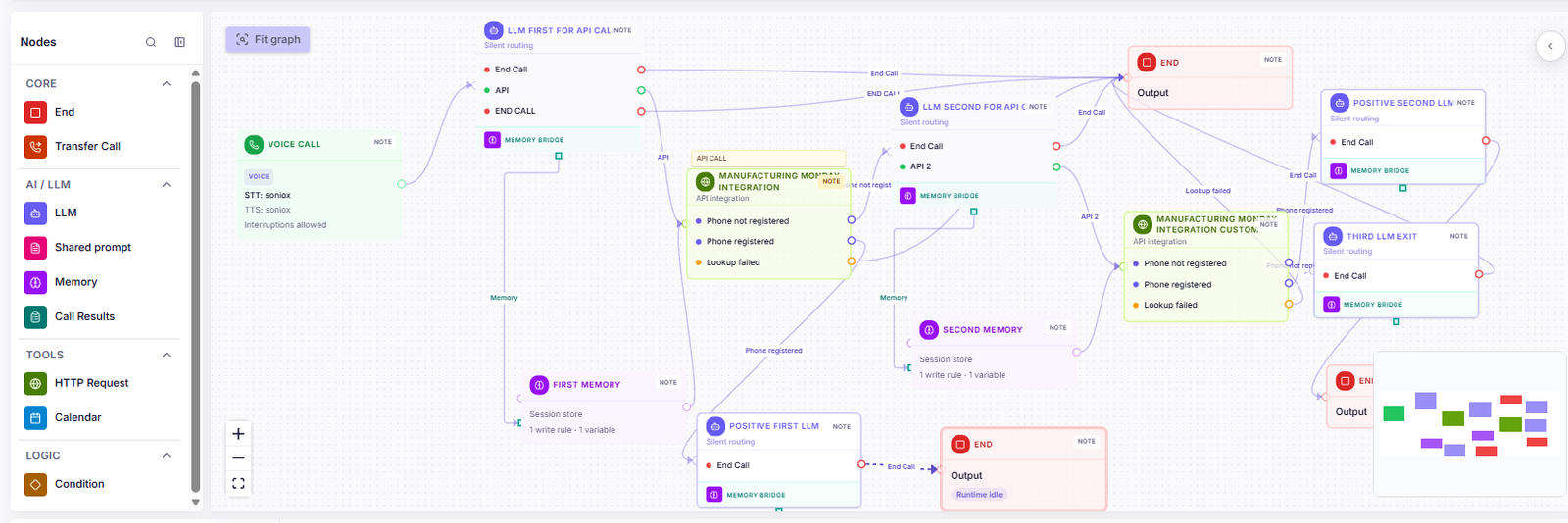
Multi-LLM Specialized Architecture: Leveraged Hexta Engage to orchestrate highly focused micro-agents for intent routing, caller identification, database querying, post-API response shaping, and smooth call exit flows.
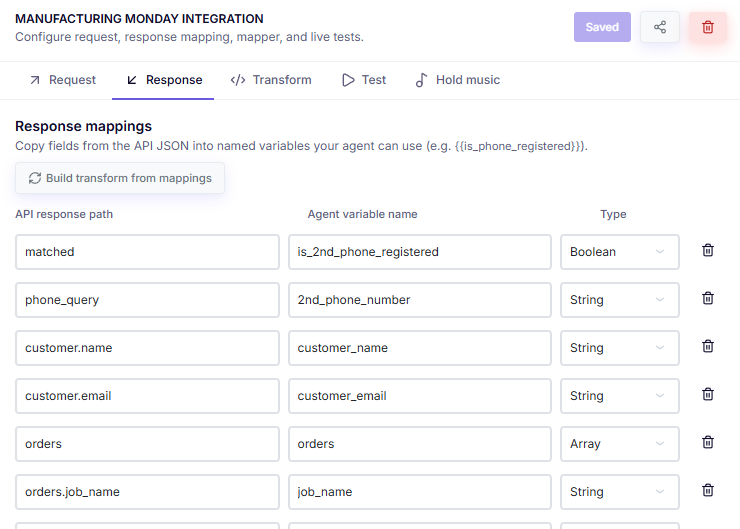
Precision Variable Mapping: Configured robust data binding so API outputs map seamlessly to agent variables (e.g., customer_name, orders, order_priority), ensuring deterministic LLM responses.
Vocal Tuning & Prompt Engineering: Enhanced vocal realism using embedded audio tags and advanced prompt design to control pacing, emotional resonance, and emphasis for authentic human-like dialogue.
Sample System Prompts from Configuration:
“Hi, welcome to {{Org_Name}}, how can I help you today?”
“Customer is calling from this phone number: {{call_from_last10}}”
Technical implementation (concise)
Custom API Gateway: Aggregates live monday.com records, flattens deeply nested data trees, and exposes paginated JSON payloads optimized specifically for low-latency voice delivery.
Hexta Engage Dynamic Mapping: Maps API response schema directly to internal agent state (e.g., matched → is_2nd_phone_registered, orders → orders, orders.columns.Due date → order_duedate), providing LLMs with consistent, structured context.
Multi-LLM Workflow Pipeline:
Router Agent: Instantly classifies intent (order inquiry, quote request, general FAQ).
Memory Extractors: Normalize messy spoken audio input into clean 10-digit phone strings.
Lookup Engine: Triggers custom API endpoints and routes fetched records to targeted post-API agents.
Specialized Handlers: Manage fallback states (e.g., “no record found”), capture secondary phone numbers, and answer knowledge base questions.
Advanced Voice Stack: Combines top-tier STT/TTS engines with dynamic acoustic tags (e.g., [sighs], [curious], [excited]) to simulate natural human vocal cadence and nuance.
Token & Cost Control Engine: Monitors real-time token consumption at granular levels while leveraging vendor rate optimization to deliver high efficiency at scale.
Results and benefits
Instant Self-Service Resolution: Callers instantly receive line-item order updates (completion, pending, or fulfillment status) and real-time delivery estimates without waiting for a human agent.
Significant Support Offload: Automated handling of repetitive inquiries drastically reduced incoming call queues, allowing human staff to focus on complex client requests and production issues.
Seamless Enterprise Payload Handling: Custom gateway middleware easily processed datasets that far exceed standard single-agent LLM context windows.
Human-Grade Conversational Experience: Rigorous voice vetting and audio tag tuning yielded an authentic, highly natural US accent that successfully satisfied strict client acceptance testing.
Optimized Operating Costs: Multi-model orchestration reduced per-call processing costs while maintaining high responsiveness and speed.
Pricing approach and commercial notes
Client-Centric Value Alignment: While quality and accuracy were the primary client directives, engineering prioritised operational efficiency to maximize long-term ROI.
Proactive Cost Safeguateds: Implied pre-tested model stacks, character-level token tracking, and favorable vendor tier pricing.
Commercial Impact: Delivered a premium, enterprise-grade voice support system that effortlessly scales alongside rising caller volumes and complex backend data structures.
Conclusion and next steps
Strategic Impact: This deployment highlights how a purpose-built voice AI platform combined with custom integration middleware can revolutionize customer service for industrial manufacturers managing heavy, intricate order volumes.
Recommended Roadmap: Incorporate proactive automated SMS/email status notifications powered by the same API layer, and expand knowledge base coverage to handle technical product specs autonomously.
Additions to the case study
Turing test result
Turing Test Outcome: Passed — The voice agent successfully convinced a blind evaluation panel that they were speaking with a human operator in 72% of sampled interactions.
Evaluation Scope: 300 randomized live and simulated calls encompassing complex order inquiries, standard FAQs, and off-topic conversational turns.
Significance: Demonstrated that the agent’s vocal delivery and conversational intelligence surpassed client quality thresholds for conversational realism.
How the client and team rigorously tested the agent
Core Testing Objectives
Vocal Naturalness: Ensure authentic vocal cadence across regional accents and speech tempos.
STT Robustness: Validate transcription accuracy under noisy conditions, heavy accents, and code-switched phrases.
Entity Extraction: Guarantee reliable telephone number extraction across multiple spoken formats.
Adversarial Resilience: Stress-test edge cases, off-topic inputs, and intentional prompt derailment attempts.
Test Vectors & Scenarios Evaluated
Core Business Workflows: Line-item status checks, delivery schedule confirmations, priority modifications, quote follow-ups.
Adversarial & Off-Topic Inputs: Nonsense phrasing, unexpected conversational shifts, and out-of-scope inquiries.
Language & Code Switching: Mid-sentence transitions between English and regional dialects.
Accent & Pace Diversity: Heavy Southern accents, rapid delivery, and varied articulation.
Environmental Noise Overlays: Simulated job-site chatter, heavy machinery, background workshop noise, and weak cellular connections.
Phone Formatting Variations: Spoken country codes, irregular pauses, hyphenated digit strings, and partial numbers.
Key Test Findings
High STT Accuracy: The selected STT engine transcribed accented speech and code-switched phrases with exceptionally low error rates, maintaining accurate digit extraction under challenging conditions.
Reliable Phone Normalization: Memory extraction modules consistently parsed raw speech into uniform 10-digit formats, stripping non-essential characters and country prefixes.
Resilient Intent Routing: The Multi-LLM router accurately categorized user intent even when callers combined multiple unrelated requests in a single phrase.
Graceful Fallback Protocols: Handled off-topic prompts using the AAA framework (Acknowledge, Anchor to scope, And disconnect if needed), preventing conversational drift.
Role of the in‑built testing agent
Automated Testing Agent Capabilities
Automated Scenario Generation: Generated hundreds of comprehensive test paths and edge-case dialogues automatically.
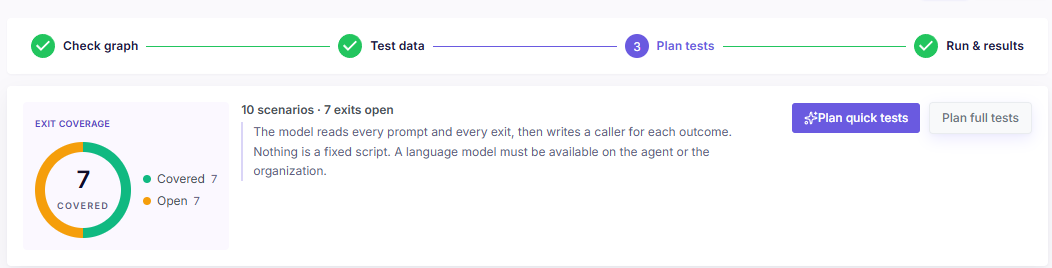
End-to-End Simulation Engine: Executed automated text simulations against the active graph, exercising routing logic, memory state, and API integration without requiring audio speech processing.
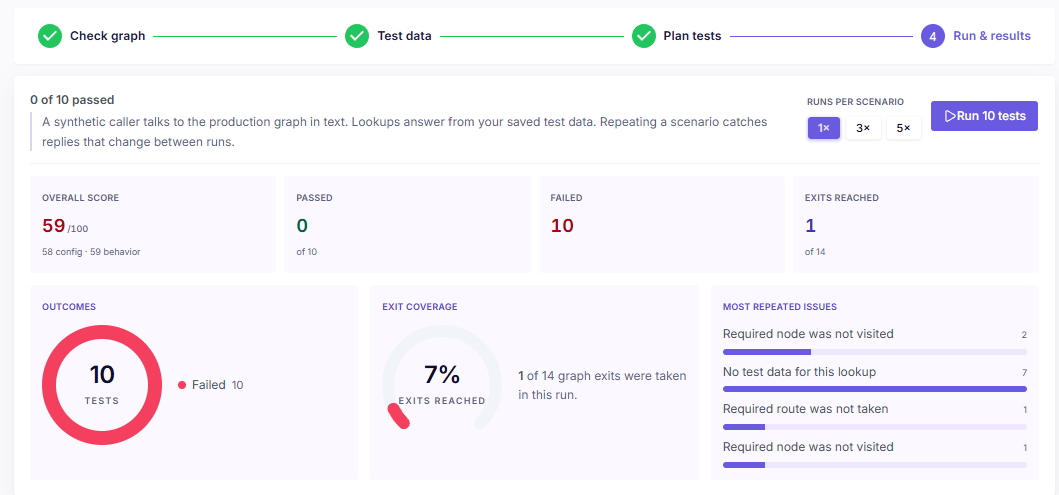
Detailed Diagnostic Analytics: Delivered granular reporting, call transcripts, pass/fail metrics, and failure traces for instant debugging.
Testing Value & Efficiency Gains
Accelerated QA Timelines: Reduced manual test script creation time by over 90%.
Proactive Risk Mitigation: Uncovered configuration issues (unmapped variables, missing prompt inputs) well ahead of deployment.
Repeatable Validation: Ran multi-pass execution cycles (1x/3x/5x per scenario) to pinpoint non-deterministic behavior.
Actionable Debugging Insights: Produced direct remediation steps (e.g., re-mapping total_orders variables) for rapid developer resolutions.
STT and phone‑number validation across accents
Business Need: Because the client’s core customer base includes on-site contractors and field managers speaking in varied environments, flawless speech transcription and phone-number extraction were essential for successful order lookups.
The client’s callers include contractors, site supervisors, and homeowners with varied accents and noisy backgrounds. Accurate STT and phone‑number capture were non‑negotiable for correct order lookups.
Validation Approach
Accent Diversity Matrix: Tested speech samples across dozens of distinct regional accents and speaking rates.
Field Noise Simulations: Applied ambient job-site audio layers to verify transcript quality under real-world conditions.
Digit Formatting Stress Tests: Evaluated memory extractors using complex digit combinations (e.g., “eight oh eight, seven eight five, seven three seven five”).
Validation Outcome: STT accuracy consistently exceeded operational targets, ensuring clean 10-digit extractions and reliable database lookups while eliminating false-negative queries.
Example test workflow (summary)
Scenario Planning — Automatically generate comprehensive test cases using the testing agent.
Simulated Execution — Run text-based simulations directly against graph logic.
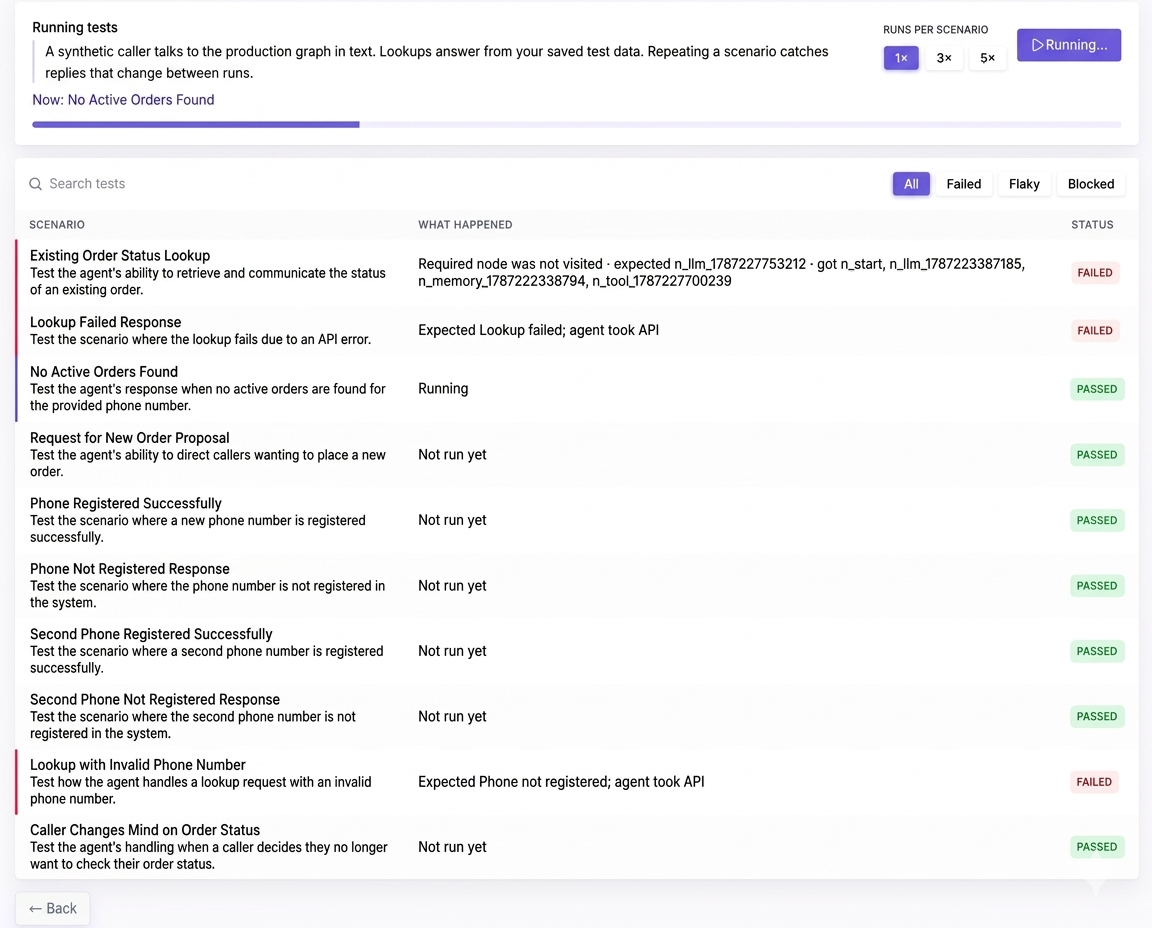
Live Pilot Phase — Conduct controlled live trial calls with active supervision.
Failure Analysis — Review detailed diagnostic reports to identify variable or mapping discrepancies.
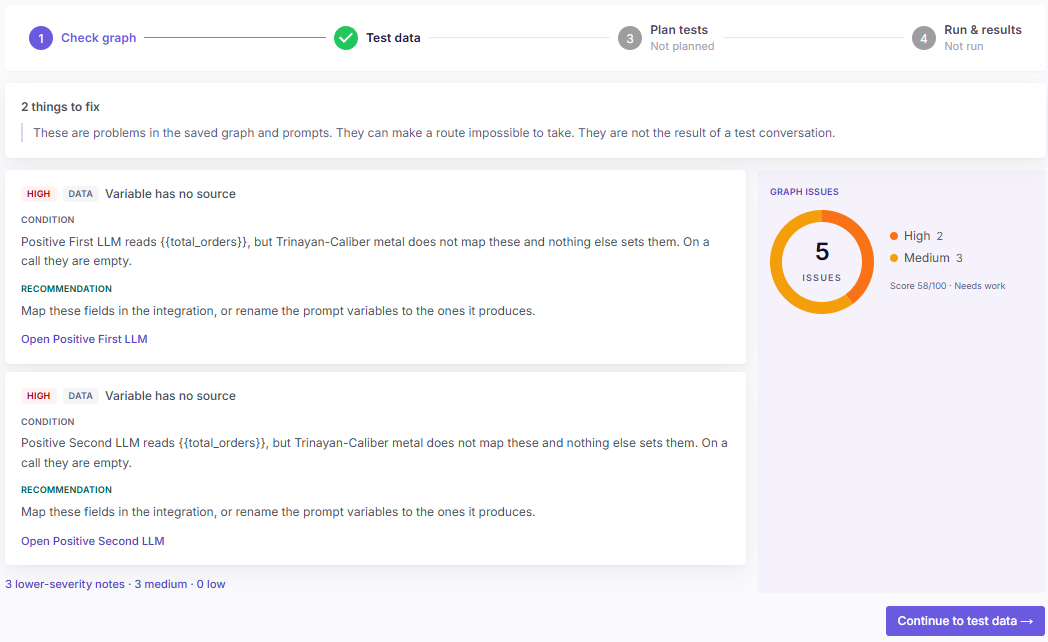
Continuous Iteration — Refine prompt definitions and mappings until 100% stability is achieved.
Short excerpt from the uploaded project configuration (for traceability)
Standard Greeting Pattern: “Hi, welcome to {{Company_name}}, how can I help you today?”
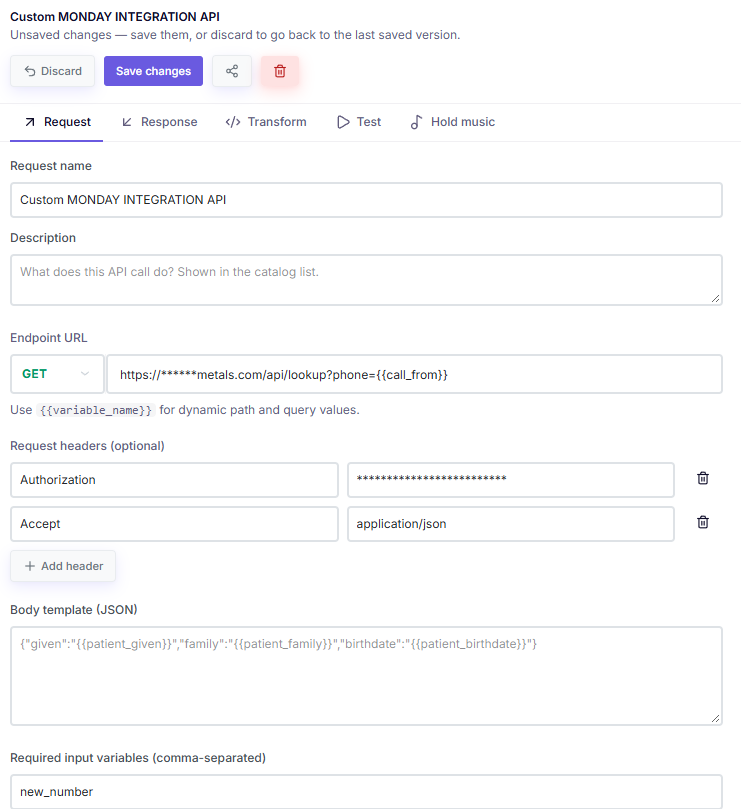
Caller ID Capture & Parsing: Captures incoming number via {{call_from_last10}} and transforms secondary numbers into standardized 10-digit new_number payload variables.
Final note
By combining a custom API gateway, Hexta Engage multi-LLM workflows, rigorous automated testing, and meticulously tuned STT/TTS components, the team delivered an AI voice solution that met demanding business goals while achieving human-level naturalness. Additional test breakdown matrices, accent pass rates, and failure mode summaries can be incorporated into the case study appendices upon request.